
Museums, Ameyoko, Akihabara — a day in Ueno adds up fast. Here's how to recover, what massage style to choose, and what to expect at a Tokyo spa as a foreign visitor.
Ueno is one of Tokyo's densest sightseeing areas. Museums, a zoo, a large park, a legendary market street, and Akihabara just one stop away — most travelers underestimate how much walking a single day here involves. This guide covers why that fatigue hits harder than expected, and how to choose the right treatment when you're not sure what any of the menu items mean.
H2: Why a Day in Ueno Wears You Out More Than You Expect
H3: Museum floors are harder on your feet than streets
Tokyo National Museum, the National Museum of Nature and Science, and Ueno Zoo all involve hours of slow walking on hard indoor flooring. Unlike walking outdoors, this kind of stop-and-go movement on unyielding surfaces concentrates pressure on the soles of your feet without giving your leg muscles a steady rhythm.
H3: Shopping bags shift the load to your shoulders
Ameyoko is one of the best places in Tokyo for souvenirs and snacks, which means most visitors leave carrying more than they arrived with. Uneven bag weight over several hours tightens the shoulders, neck, and lower back.
H3: Summer heat slows circulation
In late August, Tokyo remains hot and humid. Heat and dehydration both contribute to swelling in the legs and feet, which is why the heaviness often peaks in the evening rather than while you're still walking.
H2: Which Treatment Should You Choose?
H3: Foot reflexology — for swollen, heavy legs
The most direct choice if your feet and calves are the main problem. Common after a full day of sightseeing.
H3: Thai-style massage — for full-body stiffness
Incorporates stretching alongside pressure. A good fit if your whole body feels locked up, or if you've been sitting on trains and planes for long stretches.
H3: Momihogushi (Japanese-style kneading) — for a lighter, easy option
A more casual treatment focused on releasing tension in specific areas. A good entry point if it's your first time and you're not sure what you want.
H3: Seitai — for posture and back tension
Works on overall body balance. Often chosen by travelers dealing with lower back or shoulder strain from carrying luggage.
H3: Head spa — for eye strain and sleep issues
Useful if jet lag, screen time, or poor sleep are part of the problem, not just physical fatigue.
H2: What to Expect as a Foreign Visitor
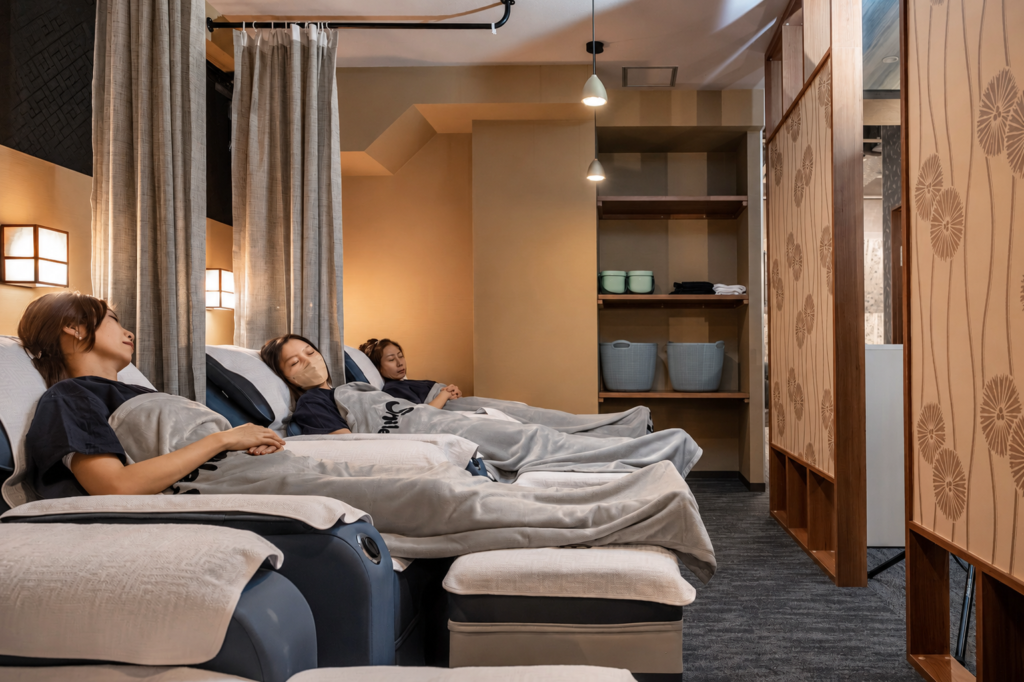
Language is the most common reason travelers skip a massage in Japan, even when they want one. At BIG FOOT SPA Ueno-Okachimachi, the menu is available in English, simplified Chinese, and Korean, and you can message us in advance via LINE, WeChat, WhatsApp, or KakaoTalk to ask questions before you arrive. Treatments take place in fully private rooms, so you can relax without worrying about shared space — which also makes it comfortable for couples and groups traveling together.
H2: Frequently Asked Questions
Q. Do I need to book in advance?
A. Walk-ins are welcome depending on availability, but booking ahead is recommended during busy seasons like summer.
Q. Can I ask questions in English before booking?
A. Yes. You can message us on WhatsApp or LINE, and our menu is available in English.
Q. Can couples or groups be treated at the same time?
A. Yes, we can accommodate multiple guests — please let us know your group size when booking.
Q. Is the shop far from Ueno Station?
A. It's within walking distance of both Ueno and Okachimachi stations. See our access page for directions.
Q. What if I don't know which treatment to choose?
A. Tell our staff how you're feeling when you arrive, and we'll recommend something based on your condition that day.
*Results and sensations may vary by individual.